
Your family archive, carefully brought into the present.
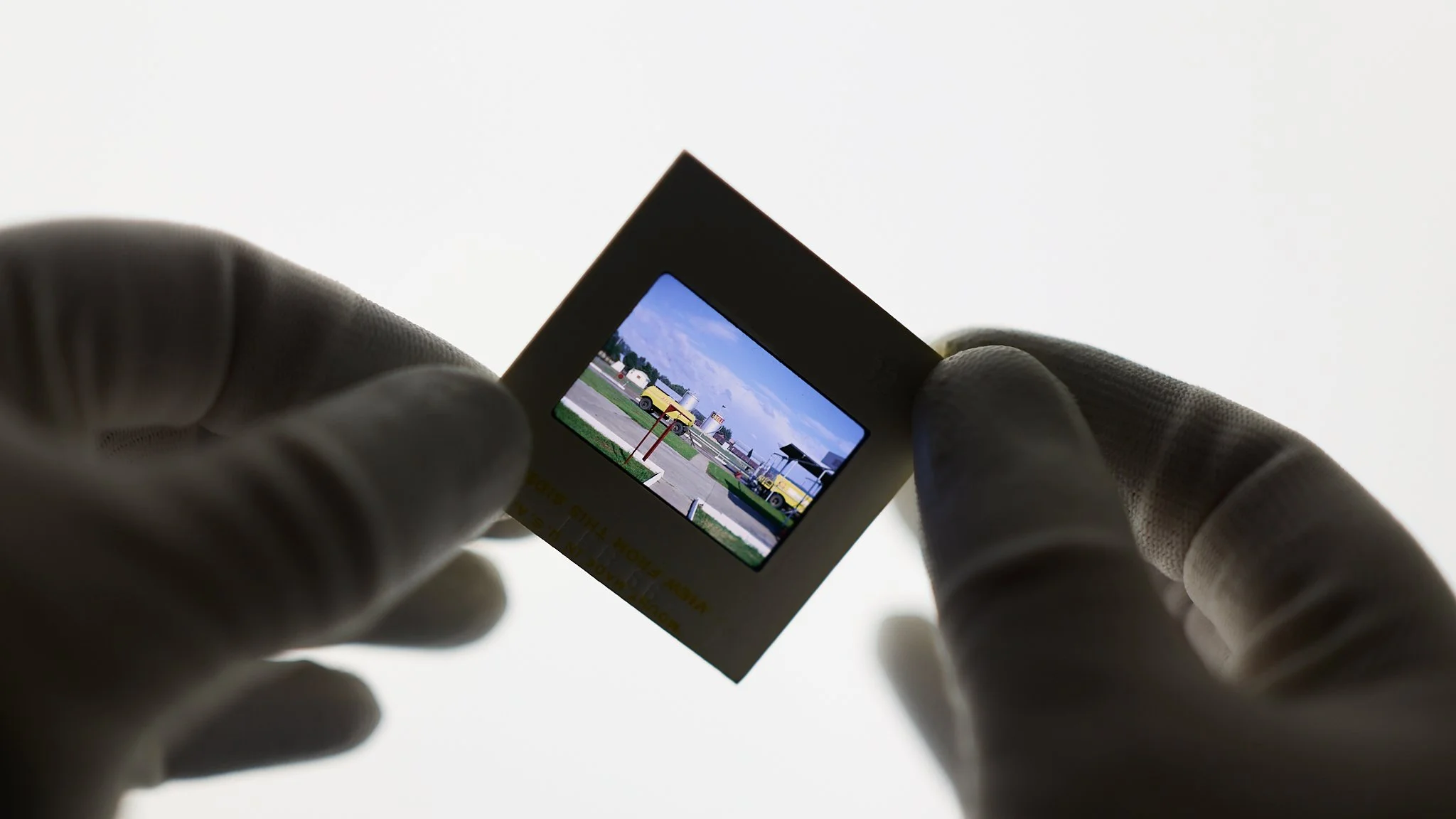
These collections often contain the only surviving record of particular people, homes and moments. But photographic materials are physical objects, and time leaves its mark. Dust settles into slide mounts, fingerprints and grime collect on film, and delicate emulsion surfaces become scratched through years of handling and storage.
We carefully digitises these photographs, preserving what remains and recovering as much of the original image as the material allows.
The archive service covers: Loose photographic prints, 35mm, 120mm & 4X5 colour and black & white negatives, mounted 35mm slides, Kodachrome and Ektachrome transparencies
At present, photographs mounted permanently inside albums or bound books cannot be scanned.
Originals must be supplied as loose prints, individual slides or accessible strips of film.
1. Understanding and preparing the collection.
Every archive begins with a conversation about what you have and what you hope to preserve. This might be an entire family collection or a particular box, period, branch of the family or group of important photographs. Names, dates, locations, handwritten notes and original numbering all help give the finished archive meaning and structure.
Before scanning, prints, slides and negatives are reviewed, separated by format and kept in their existing order wherever that order appears meaningful. Nothing is reorganised blindly or separated from the information surrounding it.
Each item is then inspected and gently prepared. Old film often carries decades of dust, grit, fingerprints and surface grime, while negatives may be curled, scratched or marked through repeated handling. Loose contamination is removed where it can be done safely, but no chemical treatment or physical restoration is performed on the original. Collections affected by mould, significant damage or unstable materials may require specialist conservation before they can be safely handled.
2. Digitisation, colour recovery and restoration.
Each photograph is scanned individually at a resolution appropriate to its original format. Film, particularly 35mm negatives and slides, can contain far more detail than is visible when casually held to the light. Careful high-resolution digitisation captures this detail while retaining the grain, texture and character of the original photograph.
Colour film is formed from separate cyan, magenta and yellow dye layers, which do not always age at the same rate. Over time, photographs can develop strong colour casts, weakened contrast, blocked shadows or thin and uneven colour. Kodachrome often remains remarkably stable when stored in darkness, while older Ektachrome and other colour transparency films can display more noticeable fading and colour shifts.
Each scan is carefully balanced to recover a natural looking image from the information still present.
This may include:
Correcting age-related colour casts
Recovering faded contrast
Balancing highlights and shadows
Reducing discolouration
Restoring a more coherent relationship between colours
Removing distracting dust, hairs, scratches and isolated marks
Deep scratches, damaged emulsion, moisture marks and severe fading may require more extensive individual restoration. Some damage is permanent, and colour information that has completely disappeared cannot be recreated reliably. Where the original appearance is uncertain, corrections are kept restrained rather than invented.
The objective is not to make an old photograph look artificially modern or erase every sign of its age. It is to create a faithful digital master that allows the photograph to be seen clearly again while preserving its original texture, character and history.
3. Building and delivering the digital archive
The finished images are organised into clearly named folders rather than delivered as an unexplained collection of numbered files.
Where information is available, the archive can be structured by:
Family or individual
Approximate year or decade
Location
Event
Original film roll or slide group
File names and folder structures are kept straightforward so the collection remains understandable to future generations, including people who were not involved in creating it.
The completed archive includes high quality master files for long term preservation and accessible copies for everyday viewing and sharing. Your original prints, negatives and slides are returned alongside the digital collection, allowing the photographs to be copied, protected and enjoyed without repeatedly handling the increasingly fragile originals.
Restoration is not about making an old photograph perfect, it is about allowing the image to be seen again. Some photographs respond beautifully: colour returns, hidden detail emerges and decades of dust disappear. Others have undergone permanent chemical or physical change. In those cases, the aim is to recover the strongest and most faithful image the surviving material can provide.
Every collection is different, and every photograph carries its age differently. Common Life approaches that history with care, preserving not only what each photograph shows, but its place within the story of a family.